DPP as a Tool for Competitive Advantage

The Digital Product Passport (DPP) is not just a regulatory initiative, but a powerful tool for businesses that want to build sustainable competitive advantage. By implementing DPP, companies can clearly demonstrate transparency, sustainability and commitment to long-term value – factors that increasingly tip the scales when choosing products, partners and suppliers.
From product lifecycle management to resource optimisation, DPP has the potential to transform business strategies and open new market opportunities.
How the Digital Product Passport creates competitive advantage
Increased transparency and trust
Transparency in business processes is one of the key ways DPP contributes to competitive advantage. Consumers and business partners increasingly demand detailed information about the origin, composition, manufacturing processes and recycling options of products.
Through the Digital Product Passport, companies can provide accurate and verifiable data about products throughout their entire lifecycle. This increases trust and positions them as reliable and responsible market participants.
Example:
A company manufacturing electronic devices provides a DPP for each product, describing the origin of materials and the tests conducted. This builds trust among customers and partners and leads to better terms in future contracts.
Sustainability as a real market advantage
Sustainability and ethics are already leading topics for consumers, institutions and investors alike. Companies that apply circular economy principles and provide transparent information about their environmental impact gain a clear competitive advantage.
DPP enables businesses to demonstrate commitment to environmental responsibility through data on materials used, recycling options and product durability.
Example:
Battery manufacturers for electric vehicles can use DPP to show how their products are recycled and reused. This attracts not only responsible consumers but also investors focused on sustainable companies.
Benefits for business models
More efficient supply chain management
The Digital Product Passport provides full traceability of products throughout their entire lifecycle. This enables earlier detection of problems in production and logistics, reduction of losses and optimisation of resources.
Especially for global supply chains and products with high safety requirements, this traceability becomes a key competitive advantage.
Example:
An electronics company uses DPP to trace the origin of its components and discovers that a certain supplier does not meet sustainability criteria. Timely switching the supplier leads to better conditions and more stable deliveries in the future.
New monetisation opportunities
DPP opens doors to new business models and additional revenue streams. Through the Digital Product Passport, companies can offer services such as repair, refurbishment, reuse and recycling of products.
These models not only increase revenue but also reduce dependence on new raw materials, while supporting the circular economy.
How DPP strengthens competitiveness
Long-term customer relationships
One of the key values of DPP is the ability to build sustainable relationships with end consumers. Providing information about maintenance, lifecycle and product updates creates trust and loyalty.
Companies can offer personalised services, updates and maintenance, which differentiates them from the competition and increases the likelihood of customers returning again.
Innovative strategic partnerships
The standardised product data that DPP provides facilitates collaboration between manufacturers, suppliers, retailers and other participants in the value chain. This leads to better coordination, lower costs and more effective partnerships.
Companies that integrate DPP early into their strategies will be better positioned for future joint initiatives and innovations.
Challenges and how to overcome them
Investments in technology and infrastructure
Implementing DPP requires investments in technology, system integration and staff training. It is also necessary to ensure compatibility between different identification and data exchange technologies, such as QR codes and RFID.
Nevertheless, these investments pay off through more efficient processes and new business opportunities.
Regulatory requirements and compliance
The upcoming regulatory frameworks related to the Digital Product Passport will require close cooperation with regulatory bodies and adaptation of internal processes.
Companies that proactively prepare and implement DPP on time will have a significant advantage over the competition.
Conclusion
The Digital Product Passport is much more than a tool for regulatory compliance. It is a strategic asset for companies that want to position themselves as leaders in sustainable production, transparency and innovation.
Over the next decade, DPP will play a key role in the development of new business models and building long-term relationships with consumers. Businesses that start integrating it today will be one step ahead of their competitors tomorrow.
WIARA and DPP
Our Solutions

DPP for Textiles
DPP provides traceability from fibre to recycling, proves brands' sustainability, and inspires consumer confidence.

DPP for the Furniture Industry
DPP ensures transparency for the materials used, facilitates reuse and recycling. It proves the sustainability of production.

DPP for Construction Products
DPP ensures transparency for the composition and sustainability of construction materials, facilitating proof of origin and compliance with standards.
DPP in Business
Frequently Asked Questions

Businesses focused on the circular economy, recycling and repairs will derive significant benefits from DPP. Product-as-a-service models, as well as secondary markets and refurbished products, will be key market segments that will benefit from DPP.
DPP will facilitate international trade by standardising product data and improving traceability. This will reduce trade barriers and make products more transparent for international partners and regulators.
Companies will face challenges related to the need for significant investments in new technologies and software solutions, as well as adapting to new regulatory requirements. Despite these challenges, companies that start preparing on time will derive serious benefits from implementing DPP.
DPP will provide companies with the ability to better plan and forecast resources and consumption. Since every part of a product will be traced throughout its lifecycle, companies will be able to predict their needs for materials and components based on real data rather than assumptions. This will increase supply chain efficiency and help optimise production processes, reducing excess costs and waste.
The Digital Product Passport will enable companies to demonstrate their commitment to quality and sustainability by providing consumers with accurate and up-to-date information about the products they buy. This will lead to better interaction between the brand and consumers, as they will be able to track product history and verify their safety, quality and recycling options. Ultimately, this will lead to stronger and more loyal customer relationships.
Latest DPP Articles

 Kiril Shivachev••5 min read
What a Digital Product Passport actually looks like — field by field

 Anita Kisimova-Dzakova••5 min read
Model, Batch or Item: Which DPP passport level do you actually need?
 Kiril Shivachev••5 min read
WIARA launches the DPP Partner Program — a new business model for consultants and agencies
 Anita Kisimova-Dzakova••4 min read
DPP for furniture: How to prove the sustainable origin of every board to the European buyer
 Anita Kisimova-Dzakova••9 min read
DPP Audit: Who Verifies Whether the Data in Your Passport Is Correct and What Are the Penalties?
 Anita Kisimova-Dzakova••6 min read
DPP in FMCG: How the digital passport ends silent packaging
 Anita Kisimova-Dzakova••9 min read
Cybersecurity and the DPP: How to protect Digital Product Passports from hackers and counterfeits
 Anita Kisimova-Dzakova••7 min read
DPP and ERP: How to Automate the Digital Product Passport Without Operational Chaos
 Anita Kisimova-Dzakova••6 min read
"Made in Europe" + DPP: A Premium Image on International Markets
 Anita Kisimova-Dzakova••6 min read
EU funding for Digital Product Passport projects
 Anita Kisimova-Dzakova••6 min read
"The Ostrich Strategy": How the Lack of DPP Can Bankrupt Your Business
 Anita Kisimova-Dzakova••8 min read
Digital Product Passport: the future of European furniture
 Anita Kisimova-Dzakova••5 min read
DPP and Ethics: The Future of Transparent Manufacturing
 Anita Kisimova-Dzakova••5 min read
The Future of DPP: What Innovations to Expect in the Next 5 Years?
 Anita Kisimova-Dzakova••5 min read
A Comparison of Regional Approaches to DPP in Europe and the USA
 Anita Kisimova-Dzakova••5 min read
DPP in Education: The Path to Sustainable Development

 Stefan Dyankov••6 min read
End of "Buy and Throw Away": The Digital Product Passport Revolution
 Kiril Shivachev••2 min read
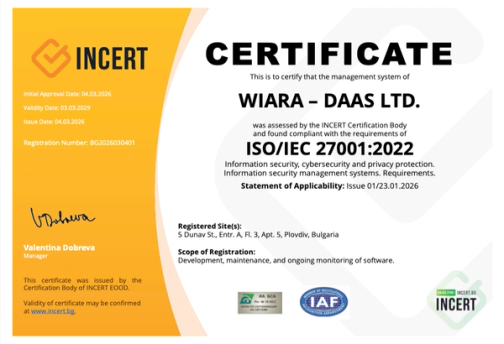
WIARA Is Now ISO 27001 Certified
 Stefan Dyankov••5 min read
DPP and Re-commerce: How the Passport Will Change Europe's Second-Hand Market
 Kiril Shivachev••6 min read
How can SMEs implement digital passports on a budget?
 Stefan Dyankov••6 min read
From compliance to competitive advantage: How to use DPP for green marketing
 Kiril Shivachev••8 min read
The Digital Product Passport (DPP) – the new digital identity card of products

DPP in Your Business
WIARA develops a comprehensive solution to help your business