From compliance to competitive advantage: How to use DPP for green marketing
European Digital Product Passport rules are gradually turning product data into the 'new currency' of sustainability. Companies that collect, organize and prove information better win more trust, partners and market share.
The regulatory framework is now clear:ESPRintroduces DPP as a sustainability, circular economy and legal compliance tool for a wide range of products. This creates a real opportunity for DPP to be seen not just as a compliance cost, but as a green marketing tool that is verifiable, audit-proof and clearly distinguishable to customers.
Why is DPP more than a regulatory requirement?
From "green promises" to irrefutable evidenceIn the European Union, pressure against unsubstantiated "green" claims is growing. Directive 2024/825 ("Empowering consumers for the green transition") tightens the rules against misleading environmental claims and labels. This means that consumers must receive clear and verifiable information.
The Green Claims Directive proposal was flagged for withdrawal in June 2025, but Directive (EU) 2024/825 already bans generic environmental claims, and the message is clear: claims without evidence and methodology are increasingly risky. This is where the DPP is most useful: instead of making promises, companies can show the data behind a claim, its source and its version.
A strategic advantage in the B2B environmentIn many sectors, sustainability is already a factor in supplier selection. DPP arranges the information so that it is machine-readable and comparable, which is especially valuable for large retail chains, industrial customers and public contracting authorities.
How to build a green marketing strategy “on” DPP
Select the "marketable" data with the highest valueNot all fields in DPP are suitable for external communication. A practical division includes:
- Customer data:composition and materials, instructions for use, care and repair, recycling options, warranty and service processes.
- Evidence:origin, certifications, methodologies (eg LCA/PCF), supply chains, versions and audits.
- Limited data:trade secrets, exact formulas, contract prices, specific suppliers.
This model reflects the real direction of the DPP pilots and the future interoperability developed through European initiatives such as CIRPASS and CIRPASS-2.
Convert DPP from QR code to PDF into a "trust page"The most common mistake is a QR code that leads to a long technical document. A more effective marketing approach is a modular, easy-to-use page that brings out the essentials of the DPP:
- What makes this product more sustainable:2–3 specific points.
- What it is made of:Materials + rates if available.
- How can I use it longer:Repair, spare parts, maintenance.
- How to return or recycle it:Local instructions and points.
- How this is proven:Certificates, methodology, date of last update.
It is important to always show date and version. By definition, DPP is dynamic, and updates are part of the trust.
Make green claims that stand up to scrutinyDue to regulations against greenwashing, any green message must contain:
- Specifics("X% recycled material", "repairability: spare parts available").
- Scope(which model, series or market it applies to).
- Method(how measured).
- Evidence(link in DPP to document, certificate or methodology).
Standards such as ISO 14067 are often used to measure carbon footprint and product emissions.
Where does DPP most often bring competitive advantage?
Batteries: Passport + deadlines for QR codesBattery regulations are now among the most specific. For certain categories there are clear deadlines for labeling and providing information (labels from 2026, QR codes from 2027). The marketing value is obvious:
- Transparency on origin, composition and recycling.
- Arguments for "longer life" and "better repairability".
- Trust in B2B chains.
Textiles: Trust vs. "green labels"Textile users are particularly sensitive to greenwashing. A digital digital passport can be a strong defense against this when it includes a material composition with verifiable sources, instructions for extending the life of the product, clear instructions for separate collection and recycling, and validated certificates. That's why projects like CIRPASS and CIRPASS-2 develop real pilots for textile chains.
Operational Roadmap: 6 Steps to "DPP-first" Green Marketing
- Step 1: Take a data inventory and find the gaps.What data do you already have (ERP, PLM, suppliers)? What are you missing for sustainable claims? What is provable and what is just a marketing goal?
- Step 2: Identify one source of truth.DPP should not be an isolated 'silo'. The best model is for it to use a central layer of data and publish it at three levels: public (customers), partner (B2B) and regulatory (control).
- Step 3: Synchronize marketable claims with legal and ESG controls.The directive increases the risk of sanctions for unclear or unverifiable messages. Therefore, green marketing should be scrutinized with the same seriousness as financial statements.
- Step 4: Turn the QR code into a "living" digital counterpart and user experience.DPP should be seen as a product profile (easy to review), a trust passport (evidence + versions) and a guide to longer product life (repair and maintenance).
- Step 5: Measure success from ESG metrics to marketing conversion.Watch for fewer support inquiries after QR scanning, more loyalty and higher success rates in B2B negotiations.
- Step 6: Plan pilots by chain and product type.The DPP will be phased in. A sensible approach is to pilot with one product line, in one market or with one partner chain, before scaling.
How the DPP helps European companies stay ahead of the competition
The DPP can set European manufacturers and exporters apart, particularly in textiles, components, electronics and assembly. Buyers increasingly look for suppliers who provide structured, verifiable information rather than marketing promises, and that applies to whole supply chains preparing for the passport under the ESPR. Practical benefits include:
- In B2B sales, DPP shortens the onboarding process (fewer emails and spreadsheets).
- In textiles, DPP builds trust where "green labels" no longer work.
- For batteries and components, early compliance with the QR/passport deadlines gives an advantage.
Conclusion: DPP is the new trust standard
It is no longer a question of if DPP will happen, but how. So it makes sense to use it as a marketing tool. When green claims are backed up with data, versions, methodology and evidence, companies gain both credibility, lower regulatory risk and stronger sales pitches.
ESPRsets the framework for the DPP as a sustainability and compliance tool, and Directive (EU) 2024/825 makes it clear that communication must be transparent and non-misleading. Together, they make "DPP-first" marketing the surest path to long-term competitive advantage.
DPP from WIARA
Our solutions

DPP for the Furniture Industry
DPP ensures transparency for the materials used, facilitates reuse and recycling. It proves the sustainability of production.

DPP for Textiles
DPP provides traceability from fibre to recycling, proves brands' sustainability, and inspires consumer confidence.

DPP for Construction Products
DPP ensures transparency for the composition and sustainability of construction materials, facilitating proof of origin and compliance with standards.
DPP
Frequently asked questions

DPP is not a marketing slogan, but a verification mechanism. Each green claim can be traced back to specific data, methodology and version of the information. When customers or partners have easy access to structured information via a QR code or digital profile, the risk of disputes, complaints or fines is significantly reduced. In other words, DPP turns sustainability from a promise into a proof.
Not all data in the DPP is intended for external audiences. For customers, information about the material composition, instructions for use and maintenance, possibilities for repair and reuse, recycling and valid certificates or standards are most useful. More sensitive data, such as suppliers or specific manufacturing processes, is usually only available to regulators or business partners. Best practice is to view DPP as a layered system where different audiences see different levels of detail.
DPP builds trust through transparency and control. More and more people want to know not only what they buy, but also where it comes from, how long it will last and what happens after use. When this information is easily accessible, up-to-date and well-structured, brands are perceived as responsible and trustworthy. This directly affects loyalty, repeat purchases and customers' willingness to pay more for provably sustainable products.
Traditional green marketing often uses general statements and visual symbols (green colors, icons, slogans). DPP-based green marketing is data-driven – using concrete metrics, verifiable sources and regular updates. This makes it more reliable, more resistant to regulatory pressure and better suited to a B2B environment where decisions are made based on facts, not emotions.
The best time is before the DPP becomes mandatory for a specific product category. Companies that start early have time to test their processes, clean up the data and build a clear communication strategy. Thus, DPP can be not only a compliance tool, but also part of the brand identity and value proposition to customers.
Latest DPP Articles

 Kiril Shivachev••5 min read
What a Digital Product Passport actually looks like — field by field

 Anita Kisimova-Dzakova••5 min read
Model, Batch or Item: Which DPP passport level do you actually need?
 Kiril Shivachev••5 min read
WIARA launches the DPP Partner Program — a new business model for consultants and agencies
 Anita Kisimova-Dzakova••4 min read
DPP for furniture: How to prove the sustainable origin of every board to the European buyer
 Anita Kisimova-Dzakova••9 min read
DPP Audit: Who Verifies Whether the Data in Your Passport Is Correct and What Are the Penalties?
 Anita Kisimova-Dzakova••6 min read
DPP in FMCG: How the digital passport ends silent packaging
 Anita Kisimova-Dzakova••9 min read
Cybersecurity and the DPP: How to protect Digital Product Passports from hackers and counterfeits
 Anita Kisimova-Dzakova••7 min read
DPP and ERP: How to Automate the Digital Product Passport Without Operational Chaos
 Anita Kisimova-Dzakova••6 min read
"Made in Europe" + DPP: A Premium Image on International Markets
 Anita Kisimova-Dzakova••6 min read
EU funding for Digital Product Passport projects
 Anita Kisimova-Dzakova••6 min read
"The Ostrich Strategy": How the Lack of DPP Can Bankrupt Your Business
 Anita Kisimova-Dzakova••8 min read
Digital Product Passport: the future of European furniture
 Anita Kisimova-Dzakova••5 min read
DPP and Ethics: The Future of Transparent Manufacturing
 Anita Kisimova-Dzakova••5 min read
The Future of DPP: What Innovations to Expect in the Next 5 Years?
 Anita Kisimova-Dzakova••5 min read
A Comparison of Regional Approaches to DPP in Europe and the USA
 Anita Kisimova-Dzakova••5 min read
DPP in Education: The Path to Sustainable Development

 Stefan Dyankov••6 min read
End of "Buy and Throw Away": The Digital Product Passport Revolution
 Kiril Shivachev••2 min read
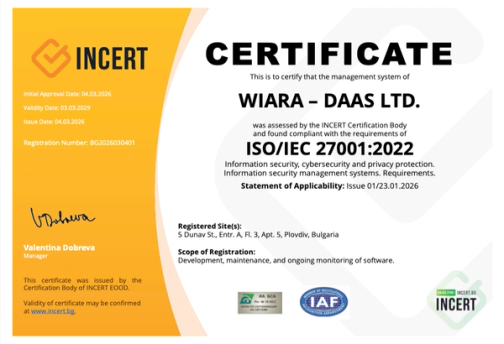
WIARA Is Now ISO 27001 Certified
 Stefan Dyankov••5 min read
DPP and Re-commerce: How the Passport Will Change Europe's Second-Hand Market
 Kiril Shivachev••6 min read
How can SMEs implement digital passports on a budget?
 Kiril Shivachev••4 min read
DPP as a Tool for Competitive Advantage
 Kiril Shivachev••8 min read
The Digital Product Passport (DPP) – the new digital identity card of products

Have questions about implementing DPP?
WIARA is here entirely to help businesses