Digital product passport: what we covered in our webinar for BASEL

On 10 November 2026 we gave a webinar on the digital product passport for member companies of the Bulgarian Association of Electrical Engineering and Electronics (BASEL). These are the main points.
Which regulation applies to an electrical manufacturer's products?
The digital product passport requirement comes from four separate EU regulations. A product permanently incorporated into a building falls under the Construction Products Regulation (EU) 2024/3110. Batteries have their own regulation, (EU) 2023/1542, and so do detergents (Regulation (EU) 2026/405). Almost everything else is covered by the Ecodesign for Sustainable Products Regulation (EU) 2024/1781.
For an electrical or electronics manufacturer, this means that different products in the same range can fall under different regulations. Cables laid in buildings are a construction product. The battery in an e-bike falls under the Batteries Regulation. Most electronics will come under the Ecodesign Regulation once the Commission adopts rules for them. Each product therefore has to be checked separately.
Some products are not expected to need a passport at all. The Ecodesign Regulation expressly excludes food, feed and medicinal products (Article 1(2)). We get enquiries from companies in those sectors too, and the answer is that the passport does not affect them for now.
When will batteries and cables need a passport?
The battery passport becomes mandatory on 18 February 2027. It is the only fixed date in the near future. It applies to every battery for light means of transport (e-bikes and e-scooters, for example), every industrial battery above 2 kWh and every electric vehicle battery placed on the market from that date (Article 77 of Regulation (EU) 2023/1542). For detergents, the fixed date is 23 September 2029.
For cables, the answer is less simple. In the webinar we filled in our questionnaire with the answers "manufacturer", "sells in the EU" and "construction products, including cables". The Construction Products Regulation sets no deadline for the passport rules. They are provisionally expected in the second quarter of 2027, and the obligation applies 18 months after they enter into force. If that timetable holds, cables will need a passport by around the end of 2028. If the rules are late, the obligation is late too.
Under the Ecodesign Regulation, iron and steel is the first product group. Its rules are expected at the end of 2026, and here too the obligation applies no earlier than 18 months after they enter into force (Article 4(4)). The timetable for each group is on our DPP deadlines page.
Selling only in your home country still counts as selling on the EU market, so a company that never exports has the same obligation as one that does.
What does a battery passport show?
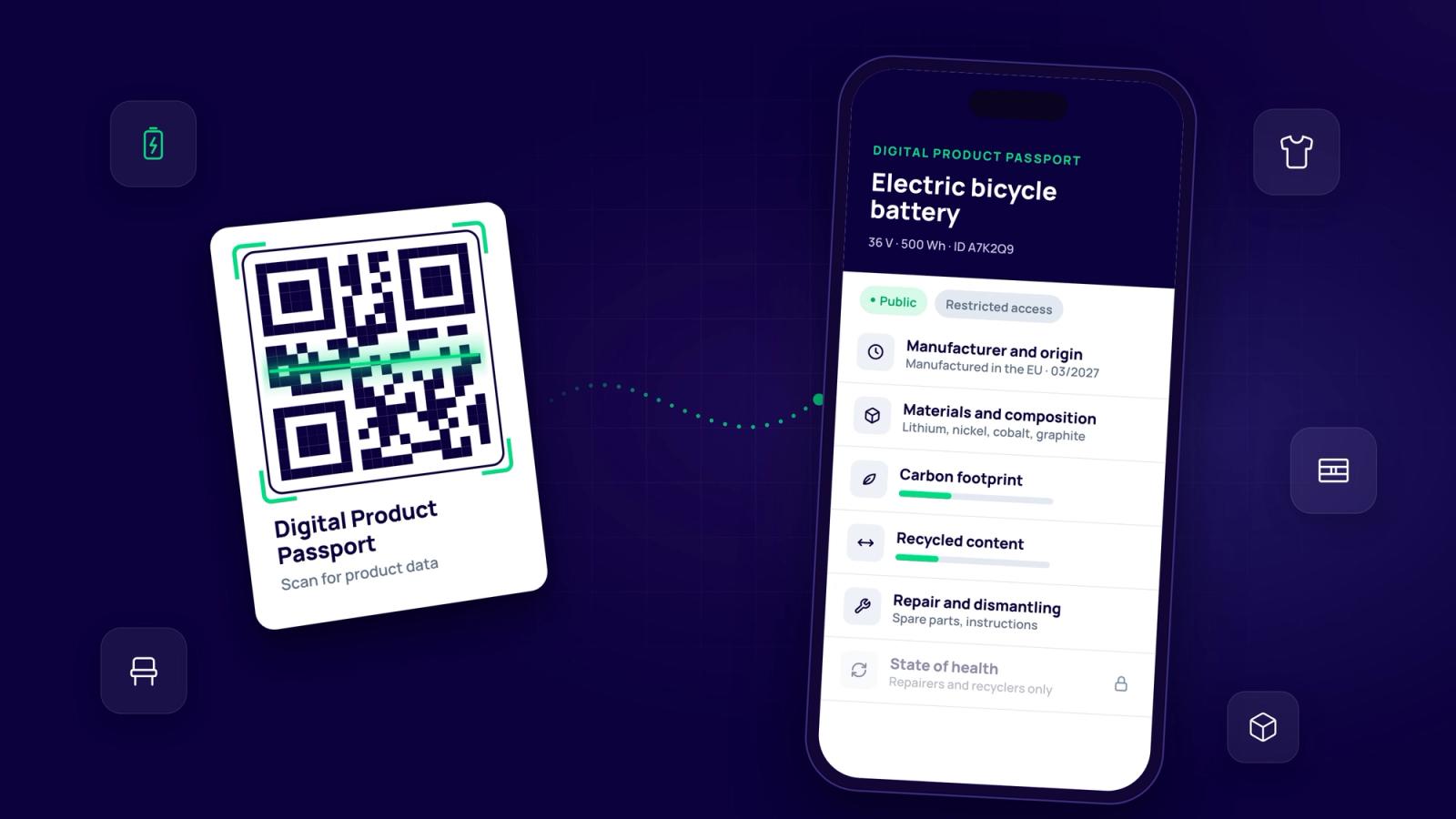
A battery passport brings together data the manufacturer usually already holds. In the webinar we showed a demo passport for an e-bike battery, and participants opened it with their phone camera, without installing an app. The company and the values in it are sample data.
The passport contains the model, the manufacturer and the serial number, the chemistry and critical raw materials, the share of recycled cobalt, lithium and nickel, capacity and cycle life, the carbon footprint and the supply chain, as well as how to dismantle the battery and where to hand it in at the end of its life. The full list is in Annex XIII of the Batteries Regulation.
The more interesting part is the data that changes. The battery management system (BMS) records the battery's state of health, its charge cycles and its power fade, and the passport is updated with this data throughout the battery's life. For older batteries without a BMS, the data is entered by hand.
Will competitors see trade secrets in the passport?
No. The digital product passport has three levels of access. Anyone with a phone can see what the product is, what it is made of, its carbon footprint and the declaration of conformity. People with a legitimate interest, such as repairers and recyclers, see more: the detailed composition, spare parts, dismantling instructions and the battery's state of health. Market surveillance authorities can also see the test reports.
For batteries, it is the law that decides who sees what (Article 77 and Annex XIII of Regulation (EU) 2023/1542), not the company. For other products, the act for each product group will decide. Commercially sensitive information is limited to what is necessary.
We are also often asked whether the data goes to the European Commission. It does not. The Commission's registry holds the product identifiers and a link to where the passport is hosted. The data itself stays with you or with your provider.
What happens to the passport if the company or its provider disappears?
The digital product passport has to remain available long after the sale. Under the Ecodesign Regulation, that means at least the expected lifetime of the product, even if the company goes bankrupt or stops trading (Articles 9 and 11). This is why the regulation also requires a back-up copy held by an independent digital product passport service provider (Article 10(4)). The back-up obligation starts when the act for the relevant product group starts to apply.
Batteries follow different rules. The Batteries Regulation does not require a back-up copy. The passport is kept by the company or by someone it has authorised, and it must remain available after the company stops trading. For construction products, the back-up arrangements are still to be set out in a future Commission act.
You can change passport provider. The product identifier stays the same, and the data is exported in an open format. The QR code points to a web address: if you own that address, you only change what sits behind it, and the labels on products already sold keep working.
Why does preparing for the passport start with the data?
Once the data is collected, the digital product passport itself takes minutes to create. Collecting the data takes months. In our experience, companies spend two to three months on the data for a single product, because some of it sits with their suppliers and some with their suppliers' suppliers.
In the webinar we therefore recommended this order. Check which regulation applies to each product. Choose one product, either your best-seller or the one customers are already asking about. Gather what you have: specifications, certificates, declarations, test reports. For what is missing, such as the carbon footprint, recycled content and substances, ask your suppliers. Sometimes the data does not exist anywhere. For residual materials of unknown origin, a laboratory analysis may be the only option. It is better to find that out with one product than with the whole catalogue.
The pressure often comes before the law does, because a large customer may ask for this data sooner. Since January 2026 the Carbon Border Adjustment Mechanism (CBAM) has applied to imported steel and aluminium, and the automotive industry is already asking its suppliers for the carbon footprint, recycled content and origin of materials.
Where are the webinar materials?
The webinar presentation is online with all its slides, in Bulgarian. The questionnaire we used to check cables is on the Do I need a DPP? page: six questions that tell you whether the passport affects your product and from what date.
Thank you to BASEL for organising the webinar and to everyone who took part. If you would like to go through your own product with us, you can book a free consultation.