DigitalProductPassport by WIARA
Digital Product Passport software that publishes passports ready for ESPR, CPR and the EU Battery Regulation
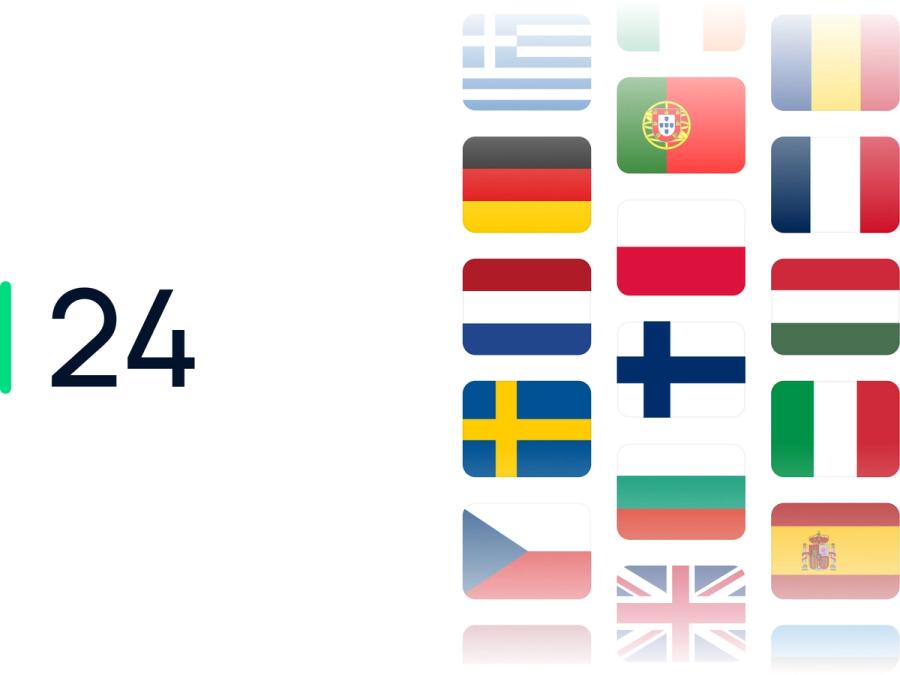
Create a passport from a ready template, publish it in all 24 official EU languages behind a GS1 Digital Link QR code, and update it whenever the product changes.
ISO/IEC 27001:2022 certified (Reg. No. BG2026030401) · Listed on G2 and Capterra · As seen on Bloomberg TV Bulgaria · Member of the CIRPASS-2 Stakeholder Community
How it works
From product data to a published passport in four steps
01
Pick a template
Templates exist for textiles, furniture, masonry, reinforcing steel, structural steel, aluminium, tyres, lighting and batteries. We maintain them as the rules change.02
Fill in the data
Type it into the form, push it from your ERP or PIM through the REST API, or upload the spreadsheets and documents you already have and let AI extract the data into the template's fields. Each field already carries its access level.03
Publish
The passport goes live in all 24 official EU languages, at a permanent GS1 Digital Link address, with a QR code you download and print.04
Update
Open a draft, preview it, publish. The live passport changes in one step, the previous version is archived, and the QR code stays the same.See it live: eleven demo passports
Each one is a working passport page for an invented product, filled with sample data and showing the fields expected for its product group. Open any of them on your phone or computer.
E-bike battery “Balkan Volt BV-360”
A battery passport under Regulation (EU) 2023/1542: chemistry and critical raw materials, carbon footprint, dynamic state-of-health data and access levels.
Winter puffer jacket “Alpina”
Materials, origin, carbon footprint, repair and recycling — a textile passport ahead of the ESPR delegated act.
Three-seater sofa “Rodopa Comfort”
Composition, origin of the materials, environmental footprint and recycling instructions for a piece of furniture.
Clay block “Trakia 25/38”
Declaration of performance to EN 771-1, EPD and carbon footprint to EN 15804, end of life.
Aluminium window profile “Alutherm AP-6063”
EN AW-6063 alloy, recycled content, carbon footprint and a working data structure under ESPR Annex III.
B500B reinforcing steel “Ferolex B500”
Chemical composition and mechanical properties from the 3.1 certificate, an electric-arc route from 96% scrap and the carbon footprint.
Summer tyre “Hemus Drive HD-205”
Today’s tyre label under Regulation (EU) 2020/740, compound composition with access levels and natural rubber origin.
LED panel “Lumiks LP-36”
Energy label and EPREL, ecodesign, RoHS and WEEE — today’s obligations for electronics in one place.
Wooden train “Dabrava DV-12”
A toy passport under Regulation (EU) 2025/2509: safety assessment, EN 71 tests and chemicals — the passport that replaces the declaration of conformity.
Laundry gel “Chista Valna Color” 1.5 L
A detergent passport under Regulation (EU) 2026/405: ingredients, dosage, hazards, digital label and refillable packaging.
Shipping box “Gofropak GY-0201”
A voluntary packaging passport carrying PPWR data: material, recyclability, declaration of conformity and sorting label.
All demos are public, filled with sample data and open without any sign-up.
Ready for All of Europe — in 24 Languages
Enter your information once. The passport is published in all 24 official EU languages: field labels come translated with the template, and your own free-text fields are machine-translated, with an “automatically translated — view original” note so readers can see your wording.
Passports for Every Business Model
Flexible traceability levels according to your production needs.
Model level — One passport for an entire product line — ideal for textiles and standardized goods.
Batch level — Tracking of a specific production series with date data and test results.
Item level — Unique digital passport for each individual unit with its own serial number for maximum traceability.
Three access levels, set field by field
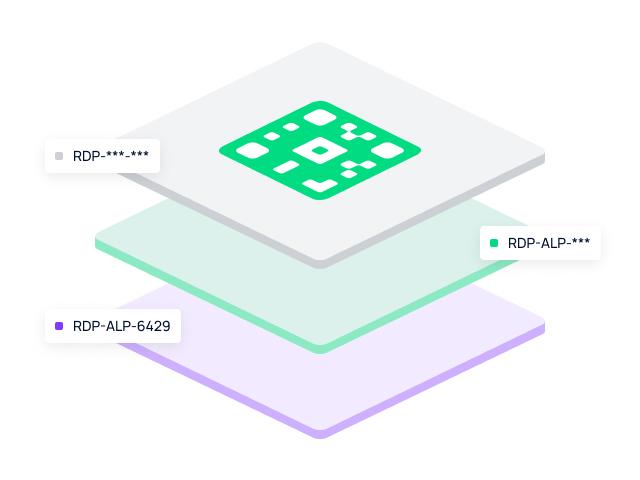
Every field and file in a template is classified to an access level. The public passport shows only the public fields.
Public — what anyone sees after scanning: materials, care, repair and recycling information.
Professional — technical data for repairers, recyclers and importers, kept out of the public passport.
Authority — certificates and test reports for market surveillance and customs, also kept out of the public passport. Authenticated access for professionals and authorities (eIDAS) is in development; it also depends on the European Commission completing its implementing rules.
Open formats, an API for everything, a full change history
Your data sits in structured fields and is published as static pages and as JSON-LD.
Static pages on a CDN — passports load in under 500 ms and stay up during maintenance.
Audit log and version history — every change is recorded with who made it and when, and earlier versions of a passport stay archived.
Full export, no lock-in — you can export all your data at any time, every passport, all files and metadata, in open formats. Every published passport also carries its data as JSON-LD (Schema.org), and everything in your account is reachable through the REST API.
Full API integration — automate the process via the REST API, connecting your ERP or PIM directly to the platform.
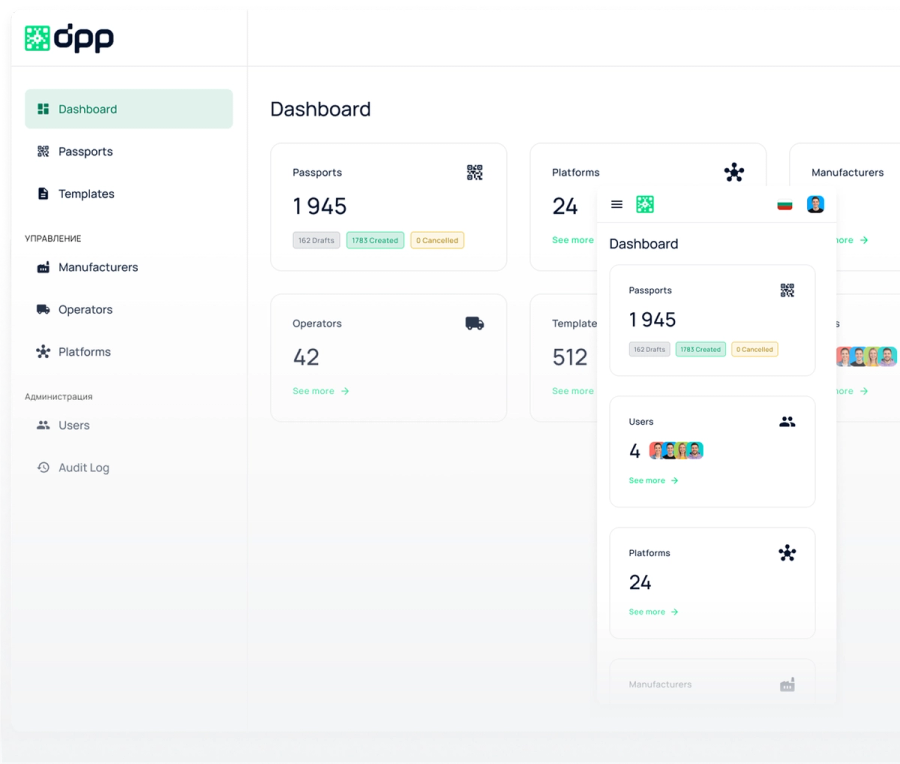
Statistics — a dashboard shows your passports by status and level, the publish rate and growth over time.
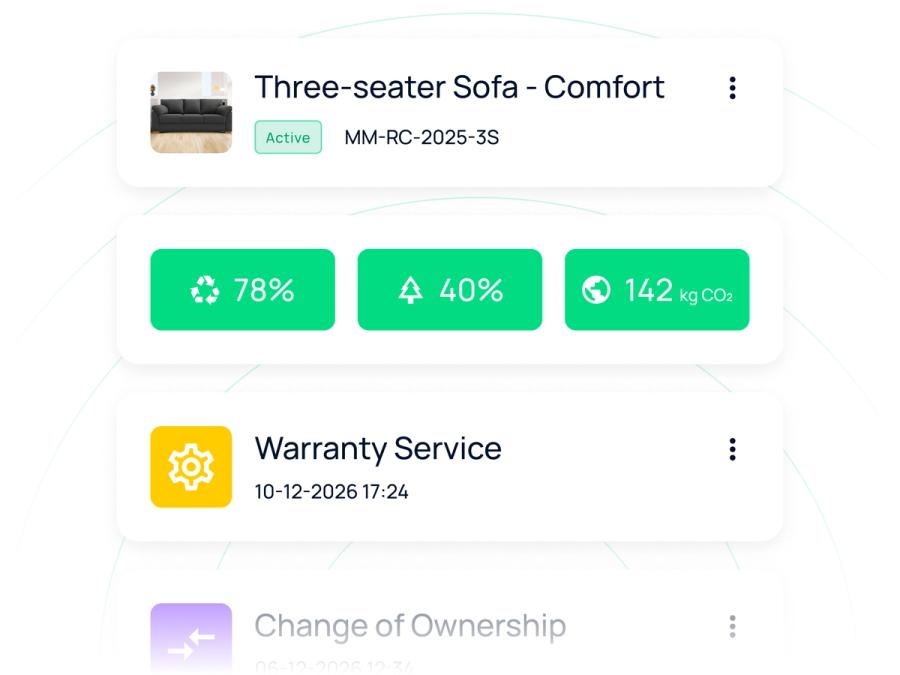
The platform is API-first
Everything you see in the interface goes through the same programmatic interface you are given — over a hundred operations documented to OpenAPI 3.0.3, plus a public GS1 Digital Link resolver conforming to ISO/IEC 18975. Connecting your ERP, PIM or PLM is therefore not a project beside the platform; it is how the platform works. Access is through personal access tokens, or service accounts with their own permissions; a secret is shown once and stored only as a hash.
More on API and integrations →
Built on the European DPP standards
The six CEN-CENELEC standards, cited in the EU Official Journal on 15 July 2026, set out how identifiers, carriers, storage and data exchange work. The platform is built around them: GS1 identifiers, QR codes, a REST API, JSON-LD, and published passports kept online for the product's full lifecycle plus ten years.
Data exchange (EN 18216 + EN 18222 + EN 18223) — passport data is served over a REST API and as JSON-LD, with per-field access classification enforced by the API.
Identification and carriers (EN 18219 + EN 18220) — every passport gets a GS1 Digital Link address built on the GTIN, and a QR code you download and print.
Published passports stay online for the product's full lifecycle plus ten years, as our own commitment.
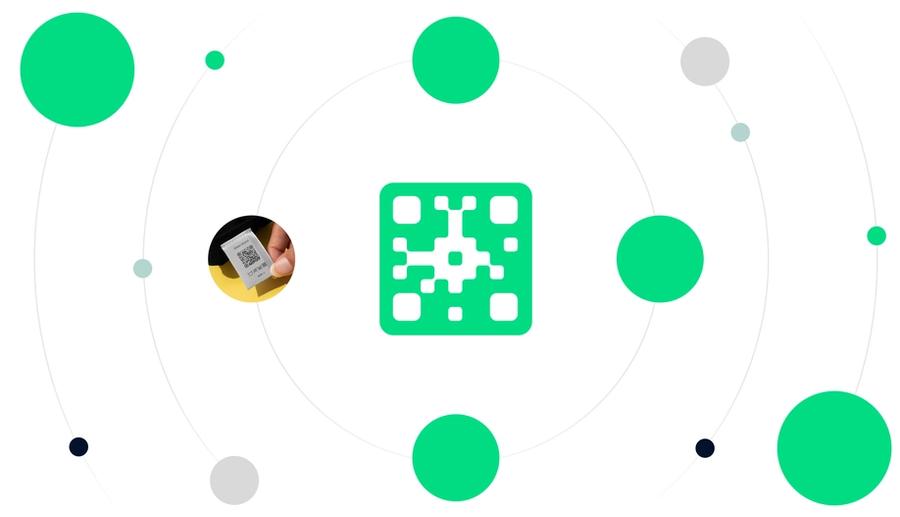
Standards & interoperability
The platform is built on the open standards of the DPP ecosystem: GS1 Digital Link (ISO/IEC 18975), GTIN, a REST API and JSON-LD, with per-field access classification enforced by the API, so the public interface cannot return a restricted field.
Ready for Tomorrow
Global visibility and automatic integration.
EU Central Registry — live since 20 July 2026 under Implementing Regulation (EU) 2026/1778. Our production connection is being built; registering a passport also requires a qualified electronic seal.
AI-Ready structure — the passport is published as structured data (JSON-LD, Schema.org), so AI agents and search engines read it directly instead of guessing from the page.
Security
- Information security management certified to ISO/IEC 27001:2022, Reg. No. BG2026030401. Read about the certification.
- Hosted on AWS in the Frankfurt region (eu-central-1), inside the EU, with role-based access and encryption.
- API secrets are shown once and stored only as a hash.
- More on security and on where your data is hosted.
What it costs
Free for 3 passports in total. Paid plans are €39, €99, €199 and €299 per month, excluding VAT, and differ in how many passports of any level they cover each month. API access is included on every plan, the free one too.
Full comparison on the pricing page.
How it compares with other approaches
Four ways companies handle product data for passports today, and where each one stops working. For a fuller comparison of cost, time, maintenance and risk:
If you use…
Where it stops working
With DigitalProductPassport by WIARA
Spreadsheets or PDFs
Where it stops working
Not machine-readable, no QR resolver, no access levels; every change is a new file to send around
With DigitalProductPassport by WIARA
Structured fields, published as a passport page and as JSON-LD behind a GS1 Digital Link QR code
Software built in-house
Where it stops working
You maintain the standards, the resolver, 24 languages, hosting and every new delegated act yourself
With DigitalProductPassport by WIARA
Templates per product group kept up to date by us; languages and hosting included
An enterprise traceability suite
Where it stops working
Built for large supply-chain programmes, with long rollouts and budgets to match
With DigitalProductPassport by WIARA
Start in the browser; connect the API when you are ready
A translation agency for each market
Where it stops working
You pay per language and per change, and the versions drift apart
With DigitalProductPassport by WIARA
One data entry, published in all 24 official EU languages
How it works in practice
Questions about the platform

No. You enter the product data once and the passport is published in all 24 official EU languages, generated from that single source. No translation agency, no separate file per country.
Every field and file in a template is classified to an access level: public, professional or authority. The public passport shows only the public fields, so commercially sensitive data does not become public because a passport exists. Authenticated access for professionals and authorities (eIDAS) is in development; it also depends on the European Commission completing its implementing rules.
Honestly: partly. The EU central registry has been operational since 20 July 2026 under Implementing Regulation (EU) 2026/1778. We work in the beta environment and the production connection is being built — registering a passport there also requires a qualified electronic seal. The identifiers and QR codes we issue follow GS1 Digital Link (ISO/IEC 18975); the EU's own rules on identifiers are expected in a delegated act in Q2 2027.
Nothing for your first 3 passports in total. After that, plans are €39, €99, €199 or €299 per month excluding VAT, depending on how many passports of any level you need each month. The pricing page has the full comparison.
Textiles, furniture, masonry, reinforcing steel, structural steel, aluminium, tyres, lighting and batteries. We build and maintain the templates; when the rules for a group change, we update the template and you are told which passports need a new version.
Yes. Everything you enter is reachable through the REST API, and every published passport carries its data as JSON-LD on a public page, so your data is in open, structured formats from the start. You can also export all of it at any time — every passport, all files and metadata — and if you leave, your data comes with you.
Book a demo or a free consultation. We look at your products, pick the closest template and demo passport, and set up your account with the templates you need.

Start with a demo
Book a free 30-minute consultation. We open the demo passport closest to your product and go through the data with you.
We show you which template fits your product and what data you need to collect for it.
Schedule a Free Consultation