Right to Repair Directive (EU) 2024/1799
What changed on 31 July 2026, and which sectors are next
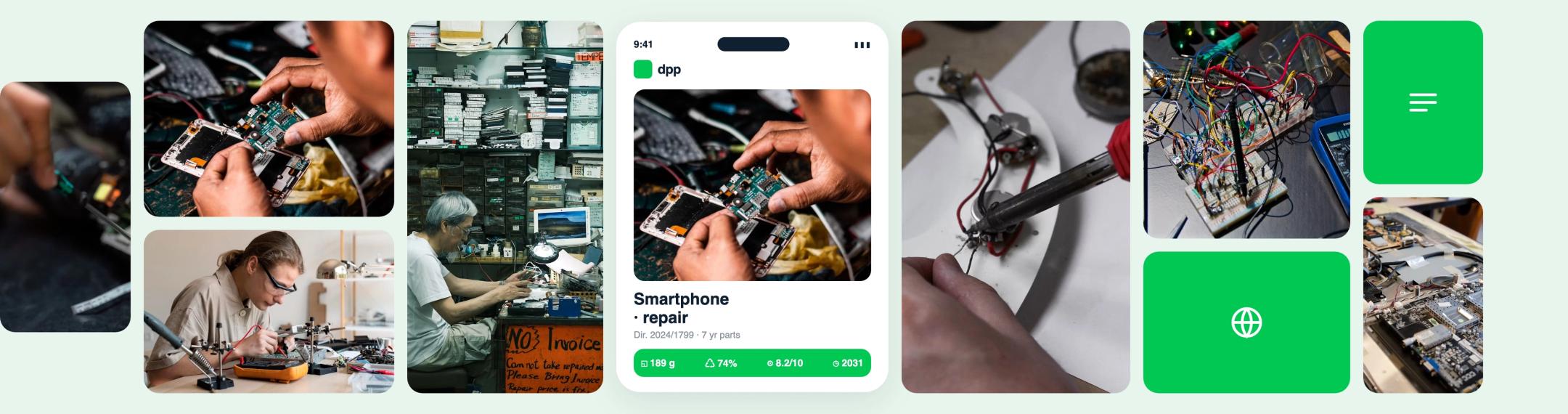
What the Right to Repair Directive is
Directive (EU) 2024/1799 was adopted on 13 June 2024 and entered into force on 30 July 2024. The 31 July 2026 deadline is a transpose-AND-apply date: Member States had to have it in national law and applying from that day.
One distinction worth keeping: that deadline binds Member States, not manufacturers directly. What a company meets on 1 August 2026 is the national transposing law, and that differs from market to market.
What does the Right to Repair Directive mean for your digital product passport?
The directive gives spare parts, repair information and repair prices a legal footing, and that is the data a passport is built to carry: repairability, durability, spare-parts availability and repair instructions. Annex II covers mainly electronics and white goods today. Furniture is named as a candidate for the 2025–2030 rollout, alongside clothing, tyres and mattresses.
Retailers and service centres are where repair requests land. DigitalProductPassport by WIARA publishes repair and spare-parts data in all 24 official EU languages from one entry, so a service centre in another country reads it in its own. Open a demo passport to see where repair data sits, or check whether your product needs a passport.
Four obligations that change the after-sales stage
What the Directive introduces
Who it affects, and when
Products in scope today
At adoption, Annex II covers household washing machines and washer-dryers, dishwashers, refrigerating appliances, electronic displays, vacuum cleaners, welding equipment, servers and data storage, mobile and cordless phones and tablets, and products containing batteries for light means of transport.
The sectors that follow
Annex II grows as new Ecodesign regulations are adopted. The Commission has signalled clothing, furniture, tyres and mattresses as candidates across the 2025–2030 rollout. The repair obligation is therefore scheduled to follow the DPP into those sectors on the same track — but it is not in force for them today.
The European Repair Platform
A new EU platform, an extension of "Your Europe", to help consumers find repairers. The Commission builds the IT; Member States manage repairer registration. It is foreseen to be operational in 2027 — it was not live on 31 July 2026.
Publish this passport with DigitalProductPassport by WIARA
The Right to Repair Directive gives spare parts, repair instructions and repair prices a legal home. A passport is the practical place to put them and keep them reachable for years.
DigitalProductPassport by WIARA is a cloud platform built by WIARA, a software company. You enter the product data once; the platform publishes a passport page with a permanent QR code and a GS1 Digital Link URL, in all 24 official EU languages, keeping public, professional and authority fields apart. ESPR and CPR templates come ready made.
The free plan covers 3 passports in total. What the platform does is set out on the product page, and the plans and their limits are on pricing.
Right to Repair and the Digital Product Passport
Frequently asked questions

No. This is the most repeated inaccuracy on the topic. The 12-month extension applies where a consumer chooses repair rather than replacement as the remedy under the legal guarantee, and it may be applied once — not on every repair.
The deadline for Member States to transpose and apply the Directive expired. It is not a date on which a manufacturer receives a direct obligation under the Directive itself — the obligation arrives through the national transposing law, which varies by market.
The repairability, durability, spare-parts-availability and repair-instruction data the DPP is built to carry is exactly what a repair-obligation regime needs. A company without it also struggles with the disclosure requirements of the Empowering Consumers Directive. Build the data once and it serves both.
Related solutions
Solutions

DPP for electronics
The most complex products among the first with a digital passport — composition, repairability, substances and critical raw materials.

DPP for the Furniture Industry
DPP ensures transparency for the materials used, facilitates reuse and recycling. It proves the sustainability of production.

DPP for Retailers and Service Centres
DPP simplifies warranties, repairs and product tracking. Retailers and service centres receive accurate information for higher quality service.