For manufacturers of labels, tags and packaging
Your customers want QR traceability. Your competitors already offer it.
Working platform · your brand · live in weeks
Why not build it yourself
The technology already exists and works. The question is not whether you will have it, but how quickly — and whose name is on it.
Live in weeks
The platform runs today. You are not starting from scratch and not waiting on a build that is measured in years rather than months.
Your brand up front
Under your name, or alongside ours. Your customer stays your customer — we do not come between you.
Built to the European standards
GS1 identifiers, QR and Data Matrix carriers, open formats. The same foundation the coming regulation rests on.
Pricing that works at volume
Per-item rates designed for millions of labels, not for dozens of product models.
What you are actually selling
Traceability is not software you sell to your customer. It is a feature of the label you already sell them.
Every label gets a unique code. The code opens a page showing whatever your customer wants shown about their product — composition, origin, care instructions, certificates, warranty. You remain the label supplier. The technology sits underneath and stays out of sight.
What separates this from an ordinary QR code is that the data is structured and lives in one place you can update at any time — without reprinting anything.
SCAN TO OPEN IT ON YOUR PHONE
LIVE DEMO
Here is what it looks like on a real product
A winter jacket — the passport shows composition, origin, carbon footprint, care and recycling instructions. It is exactly what the end customer sees after scanning the label. Open it on your phone and show it to your customer tomorrow.1. The code goes into the print run
Unique codes are generated up front and fed into your printing process as ordinary variable-data print. Your equipment stays as it is. No new machines, no new consumables suppliers, and no change to how you take orders.
2. The data is entered once
3. The customer scans
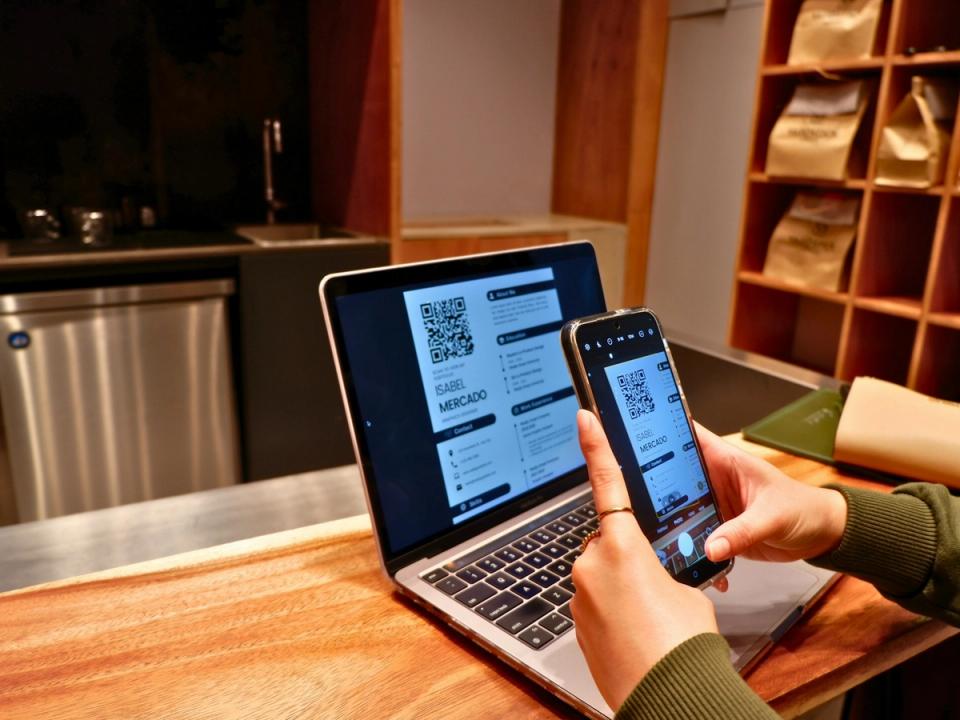
The end user scans with the ordinary camera on their phone. No app, no sign-up. Your customer sees how often and where their product has been scanned — which for many brands is the first real channel they have ever had to the buyer.
Your brand or ours — you decide
We work both ways and have no preference which you choose. White-label: the platform carries your name and your design. To your customer, traceability is a product of your factory. We appear nowhere and have no contact with your client. Co-branded: you stay the commercial partner and we are visible as the technology one. The practical advantage is that your customer’s technical questions come straight to us, so you do not take on support that is not your job. Either way, the contract is between you and your customer. The price you quote them is yours to set.
Discuss both modelsWhat about the regulation?
The traceability you sell today is not mandatory. That is precisely why it sells — your customer wants it now, for reasons of their own.
But the same structure becomes a requirement later. The ESPR regulation introduces the digital product passport group by group, and the timetable through 2030 is already published. Textiles are among the first.
The practical consequence for you: what you sell today as an advantage will be sold tomorrow as an obligation. Whoever already has it will not be building it against a deadline — and will be the only label supplier able to answer “already done”.
How DigitalProductPassport by WIARA uses this
Traceability is what a label or packaging producer sells the moment the code on the pack leads somewhere real.
DigitalProductPassport by WIARA is a cloud platform built by WIARA, a software company. It builds each passport around the identifier you already use, issues a GS1 Digital Link URL with a permanent QR code for the label, and serves the same data as JSON-LD for machines and as an accessible page in 24 EU languages.
The free plan covers 3 passports in total. What the platform does is set out on the product page, and the plans and their limits are on pricing.
Traceability
The questions we get most often

Your customer does. We are a processor, not a controller. On a white-label arrangement we have no contact with them at all. The data is held in an open format and can be exported at any time — no vendor lock-in.
The content changes, not the label. The code stays the same and the page behind it updates. That is the one thing a static QR code cannot do.
Traceability is the capability; the passport is its regulatory form. If you have the first, the second is configuration rather than a new project. It does not work the other way round — which is why we start here.
The model is built for long runs. At a few thousand labels a year the arithmetic is hard; at millions it works comfortably for both sides. Exactly where the line falls depends on whether the code sits on the item, the batch or the model — we work that out case by case.
The platform is API-first
Everything you see in the interface goes through the same programmatic interface you are given — over a hundred operations documented to OpenAPI 3.0.3, plus a public GS1 Digital Link resolver conforming to ISO/IEC 18975. Connecting your ERP, PIM or PLM is therefore not a project beside the platform; it is how the platform works.
More on API and integrations →

Let us look at it on your product
Thirty minutes online, or we come to you. We bring a demo built on one of your actual products, not a slide deck.