DPP and Extended Producer Responsibility: What EU Manufacturers Need to Know

If you manufacture for the EU market, extended producer responsibility is not new to you. Producers already pay into schemes for packaging, batteries and electrical equipment. For many companies it still feels like a tax: a fee to a producer responsibility organisation, calculated from the tonnes placed on the market, with little connection to how the product was designed.
That connection is now being made. EPR fees are increasingly modulated by the characteristics of the product, and the Digital Product Passport is where those characteristics are recorded. Your responsibility as a manufacturer no longer ends at the loading bay. It follows the product through use and repair to the point where it becomes raw material again.
What is changing in EPR
EPR was built to pay for collection and recycling at the end of a product's life. The EU framework now pushes the question upstream, to design.
The Ecodesign for Sustainable Products Regulation (ESPR) sets requirements for how products are made: durability, repairability, recycled content, substances of concern. The DPP is how a manufacturer shows that its product meets them, and the same data is what an EPR scheme needs to set a fair fee.
Textiles are the next EPR obligation
The revised Waste Framework Directive, (EU) 2025/1892, makes EPR for textiles mandatory across the EU. Member States must transpose it by 17 June 2027, textile EPR schemes must be in place by April 2028, and micro-enterprises get one more year, until 17 April 2029. The obligation is European. Fee levels, registration and the ways of meeting it are national, so a brand selling into several Member States will deal with several schemes.
Packaging is a separate obligation under the Packaging and Packaging Waste Regulation (EU) 2025/40, which applies from 12 August 2026. A clothing brand will usually pay for the garment and for its packaging under different schemes.
From flat fees to eco-modulation
Eco-modulation means the fee depends on the product. Schemes adjust it for characteristics such as recyclability, recycled content, durability, repairability and the presence of hazardous substances.
- A product that is easy to take apart and recycle pays less.
- A product made of materials that cannot be separated, or containing substances of concern, pays more.
To qualify for a lower rate you need evidence: composition, recycled content and end-of-life information, which is exactly what a passport holds. Without it, a product is unlikely to get the lower fee.
How the DPP helps
Reporting from one source
EPR reporting is still largely manual: weights and material shares compiled from spreadsheets every quarter or year. When composition, weight and origin already sit in structured passports, the declaration can be generated from the same data, with fewer errors to explain at an inspection.
Answering your customers
Many manufacturers supply larger brands and retailers, and those customers need product data for their own EPR declarations and sustainability reporting. A supplier that cannot deliver it in a usable digital form becomes a risk in the supply chain, however good the product.
Supporting repair and reuse
Longer product life is one of the aims of EPR. A passport can carry:
- Disassembly instructions and repair guides.
- A spare-parts catalogue and where to order from it.
- Software and firmware information for products with electronics.
Published openly, this information helps meet the legal requirements and supports the reputation of a brand that builds products to last.
Which sectors feel it first
The passport reaches product groups in stages, and its dates are not the same as the EPR dates. As things stand:
- Batteries: the battery passport is required from 18 February 2027 under the Batteries Regulation, a separate law from the ESPR.
- Iron and steel: the first product group in the Commission's ESPR working plan.
- Textiles and apparel: EPR schemes by April 2028, while the ESPR delegated act for textiles is expected in 2027 and will apply only after a transition period.
- Furniture: a priority group in the working plan, with requirements expected to cover materials, repairability and recyclability.
Practical challenges
Implementing a passport takes work. For small and medium-sized manufacturers, three points tend to hurt most:
- No digital record. Many companies still keep product data on paper or in scattered spreadsheets. Moving it into one structured source is the first and hardest step.
- Supplier data. A passport is only as complete as the data on its components. If a raw-material supplier outside the EU will not share composition data, the gap is yours to close.
- Confidentiality. Some passport data is public and some is for professionals or authorities only. The platform has to keep those levels apart so that trade secrets stay protected.
Where to start
- Audit your data. Do you know the exact material composition of the product and of its packaging? Can you document where each raw material comes from?
- Talk to your PRO. Ask your producer responsibility organisation how and when it plans to modulate fees, and what evidence it will accept.
- Choose the system. Look at product-data platforms or DPP providers that integrate with your ERP rather than duplicating it.
- Brief the team. Design, engineering and purchasing make the decisions that set the fee, so they need to know how it is calculated.
A fee you can influence
The passport turns extended producer responsibility from a flat charge into a fee that reflects how a product is made. For manufacturers that compete on quality rather than on price, that is an opportunity to prove it with data, and to be seen as a transparent and reliable partner by customers across the single market.
Our solutions
DPP for different industries

DPP for Construction Products
DPP ensures transparency for the composition and sustainability of construction materials, facilitating proof of origin and compliance with standards.

DPP for Retailers and Service Centres
DPP simplifies warranties, repairs and product tracking. Retailers and service centres receive accurate information for higher quality service.

DPP for the Furniture Industry
DPP ensures transparency for the materials used, facilitates reuse and recycling. It proves the sustainability of production.
You ask us:
Frequently asked questions

Responsibility sits with the economic operator that places the product on the EU market: the manufacturer, or the importer where the manufacturer is outside the EU. - As the responsible operator, you need the data from your suppliers. - If they cannot or will not provide it, you may have to commission measurements or analyses yourself, for example of carbon footprint or chemical composition, to produce a valid passport. - Once the requirements for a product group apply, the ESPR also gives customs authorities a role in checking that products carry the passport they need.
Not for now. EPR reporting runs through national producer registers, and the EU DPP registry is not a channel for EPR declarations. What changes is the preparation: when the data sits in structured passports, the report is generated from it instead of being compiled by hand. Expect to report separately for some time.
When you produce goods that are sold under a brand's name, the brand is normally responsible for the passport. You will still be asked for production data: materials, processes, energy use and certificates. That data ends up in the brand's passport, and a contract manufacturer that cannot supply it puts the contract at risk.
Penalties under the ESPR are set by each Member State, and market surveillance authorities can require corrective action or have a product withdrawn from the market. Because much of the passport is public, a mismatch between the passport and the real product can also amount to a misleading claim to consumers, with its own legal and reputational cost.
WIARA with an end-to-end DPP solution
Our solutions

DPP for End Consumers
DPP provides transparency – composition, origin and recycling of products, so consumers can choose responsibly and make informed decisions.
DPP for Construction Products
DPP ensures transparency for the composition and sustainability of construction materials, facilitating proof of origin and compliance with standards.
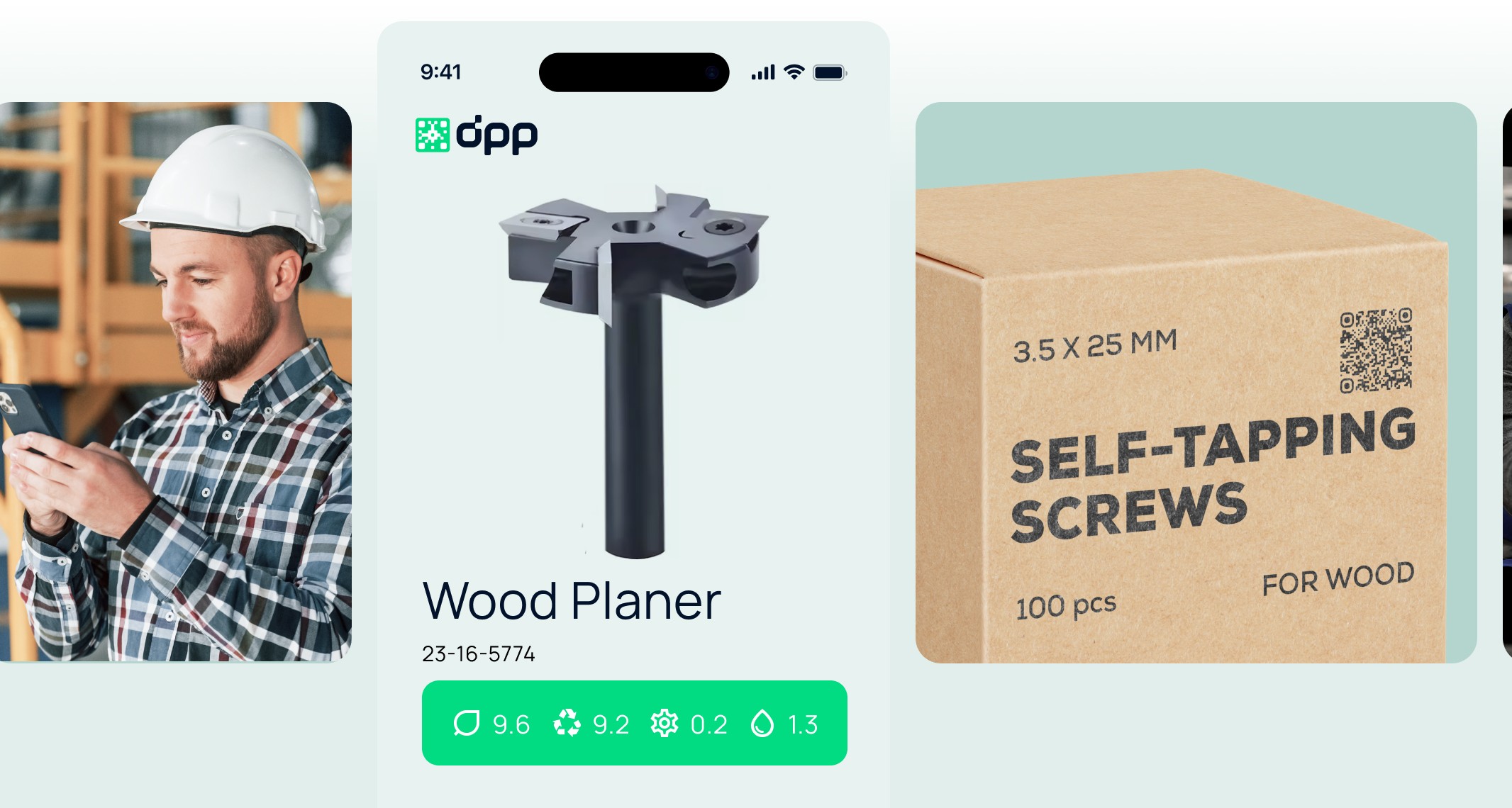
DPP for Manufacturers
Manufacturers create and maintain DPP, prove compliance and sustainability, earn trust and improve their processes.

WIARA at your business's service
Implement the DPP in your production process quickly, easily and efficiently